
We face difficult technology questions every day. From deciding what tools to invest in, to understanding what will support business growth, to determining how to keep that technology secure. In this blog, we explain what Break/Fix, Managed IT, and Co-Managed IT models are and what they may mean for your business. Read on to learn the key differences and what to consider when choosing the approach that aligns best with your needs.
Why Understanding IT Support Models Matters
Every business relies on technology to operate, communicate, and serve customers. However, the ways organizations choose to maintain and support their technology can vary significantly. IT support models such as Break/Fix, Managed IT, and Co-Managed IT differ in cost structure, involvement level, and responsibilities.
There is no single solution that works for every business. Some organizations may only need occasional assistance, while others benefit from continuous oversight or a partnership that complements internal IT staff. Understanding how each model functions can help you assess which approach aligns with your operational requirements, budget, and long-term plans.
What Is Break/Fix or Traditional IT Support?
Break/Fix IT is a traditional, reactive support model where businesses contact an IT professional only when an issue arises. Instead of a monthly fee, organizations pay for service on a per-incident basis. This may include troubleshooting, hardware repairs, software issues, or system outages.
In this approach, a business typically manages its day-to-day IT needs internally and seeks outside help only for problems that exceed internal capabilities. Because there is no ongoing monitoring, the technician may need additional time to diagnose the environment before resolving the issue.
Break/Fix support generally involves:
- Reactive service: A technician is contacted after a problem is identified.
- Downtime: Due to the reactive nature of Break/fix IT support, downtime can happen more frequently and for longer periods.
- Variable costs: Charges depend on the time and resources required for each incident.
- As-needed support: Service is provided only when issues arise, with no ongoing maintenance.
- Limited historical context: Since the provider is not continuously involved, they may not be familiar with system configurations or past issues.
What Are Managed IT Services?
Managed IT Services is a proactive support model where a Managed Service Provider (MSP) takes ongoing responsibility for monitoring, maintaining, and supporting a business’s technology. Unlike Break/Fix, which reacts only when problems occur, managed IT focuses on preventing issues before they impact operations.
Businesses typically pay a predictable monthly fee, giving access to consistent support and specialized expertise. Because the MSP regularly works with your systems, they quickly become familiar with your environment, which can help reduce downtime.
Managed IT services generally involve:
- Proactive monitoring: Identifying and resolving issues early.
- Uptime: Due to the proactive nature of MIT support, longer periods of uptime can be expected.
- Predictable costs: Monthly fees provide budgeting stability.
- Ongoing maintenance: Regular updates, security patches, and system checks.
- Familiarity with your environment: Speeds up troubleshooting when problems arise.
This model is often suited for organizations that want consistent coverage and structured IT support.
What Is Co-Managed IT?
Co-managed IT is a hybrid approach designed for organizations that already have internal IT personnel but need additional support. Rather than replacing in-house staff, an MSP works alongside them to share responsibilities.
This collaboration can be structured in several ways, such as:
- The MSP handling routine monitoring or maintenance while internal IT focuses on projects.
- The internal team managing day-to-day support while the MSP provides specialized expertise.
- Both parties sharing responsibilities based on capacity, tools, skill sets, or business needs.
Co-managed IT offers flexibility for organizations seeking to expand their capabilities without fully outsourcing their technology management.
How Break/Fix Compares to Other IT Models
The primary differences among Break/Fix, Managed IT, and Co-managed IT involve the level of ongoing involvement:
- Break/Fix: Support is provided when something goes wrong.
- Managed IT: Continuous monitoring and proactive maintenance.
- Co-Managed IT: Internal resources blended with external support.
Each model serves different needs. Understanding the structure, cost expectations, and support style of each option can help businesses determine which aligns best with their technology requirements and internal capabilities.
Choosing the Right IT Support Model
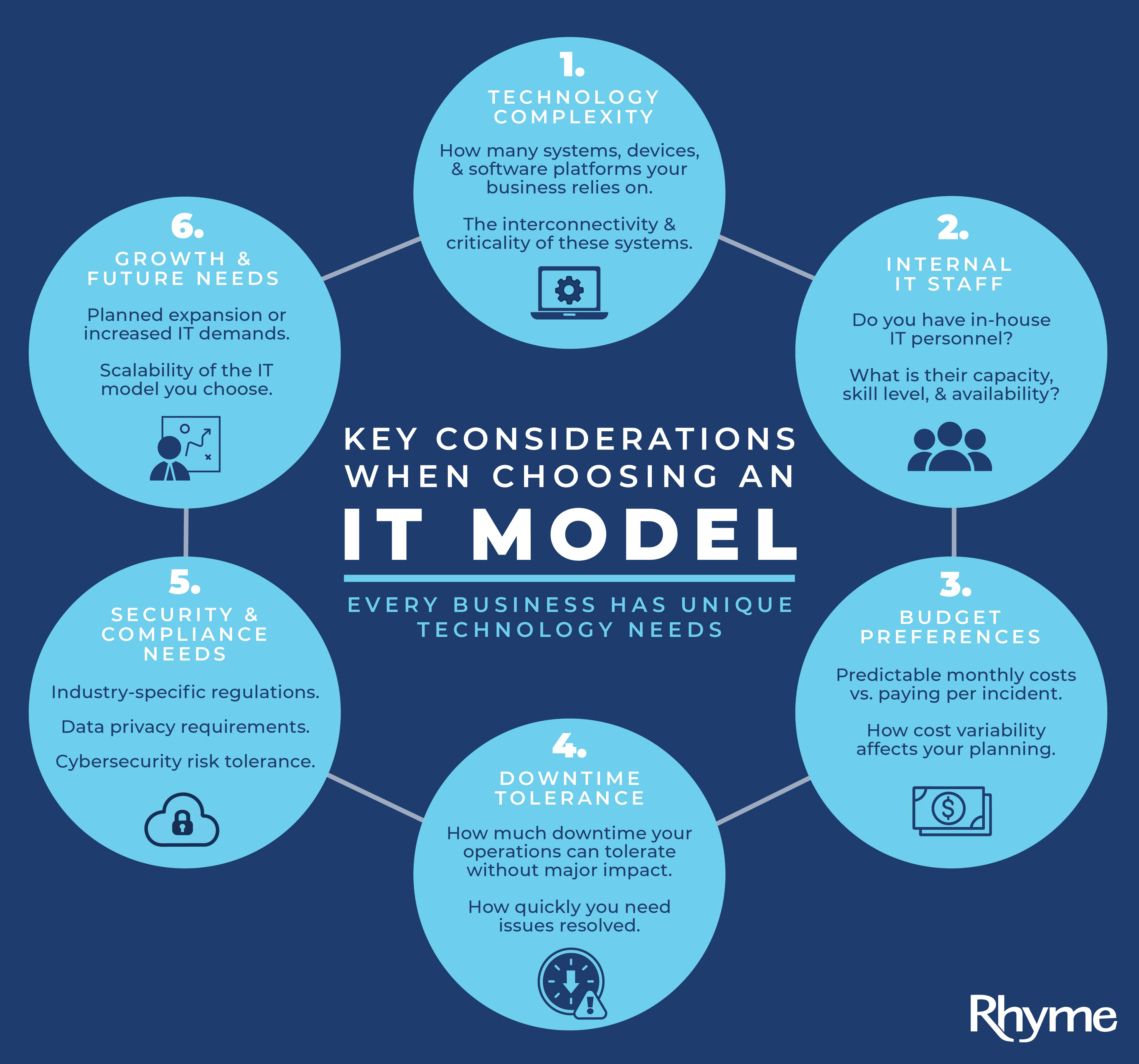
When evaluating Break/Fix, Managed IT, and Co-Managed IT, businesses may want to consider factors such as:
- The complexity of their technology environment
- The presence and capacity of internal IT staff
- Budget preferences, including predictable costs vs. per-incident expenses
- How much downtime their operations can tolerate
- Security, compliance, or industry-specific requirements
- Anticipated growth and future technology needs
Assessing these elements can help organizations select the approach that fits their goals and operational style.
Break/Fix, Managed IT, and Co-Managed IT each offer distinct methods of supporting business technology. The right option depends on your budget, staffing, system complexity, and long-term objectives. By understanding how these models work, organizations can make informed decisions that help maintain stability, security, and efficiency within their technology environment.
Find out if Rhyme IT Managed Services are right for you.
Speak with one of our technical experts about your technology needs HERE or call us at (800) 362-4333.
Updated: 12/17/2025